- Trade Truce & Turbulence
- Posts
- Consumer Cargo Choked, Ethiopia Gets Offensive & U.S. Forces Stretched Thin?
Consumer Cargo Choked, Ethiopia Gets Offensive & U.S. Forces Stretched Thin?
Edition 2: Week Ending January 7, 2024
Edition 2: Week Ended January 7, 2024
(1) Iranian-Backed Houthi Rebels Send Containerships Around South Africa
The Scoop: a defensive western military strategy and persistent Houthi strikes send 70%+ of Red Sea bound containers around Africa with no signs of relief.
The Importance: box rates are surging off post-covid lows. Sharp upward moves in shipping costs are a leading indicator of inflation. Below we show, U.S. Inflation (Left-Axis) and the Drewery World Box Index (“box rates”, Right Axis). (full story below)
(2) Ethiopia Trades Nationalized Airline Shares for Red Sea Access
The Scoop: Ethiopia agrees to a 50-year lease of Berbera port with a breakaway region in Somalia. Landlocked Ethiopia plans to boost trade and establish a naval presence. Ethiopia recognized, internationally unrecognized, Somaliland. Somaliland was given partial ownership of Ethiopian Air, Africa’s largest carrier.
The Importance: Ethiopian PM Abiy Ahmed warned a land-locked Ethiopia would go to war for access to the sea last year. It may be a short-term agreement with plans to launch attacks on Somalia or Eritrea later. (full story below)
(3) Ukraine, Israel, Now South Korea Goes on High Alert
The Scoop: Tension builds in the Middle East. Meanwhile, South Korea went on high alert on January 5th. North Korea began firing hundreds of artillery shells towards Yeonpyeong Island. Citizens sheltered and were later evacuated.
The Importance: Conflict has been growing across three regions since Russia invaded Ukraine. It has put strain on U.S. military assets. Despite outsized spending, is the U.S. military being stretched in a collective effort by U.S. adversaries? (full story below)
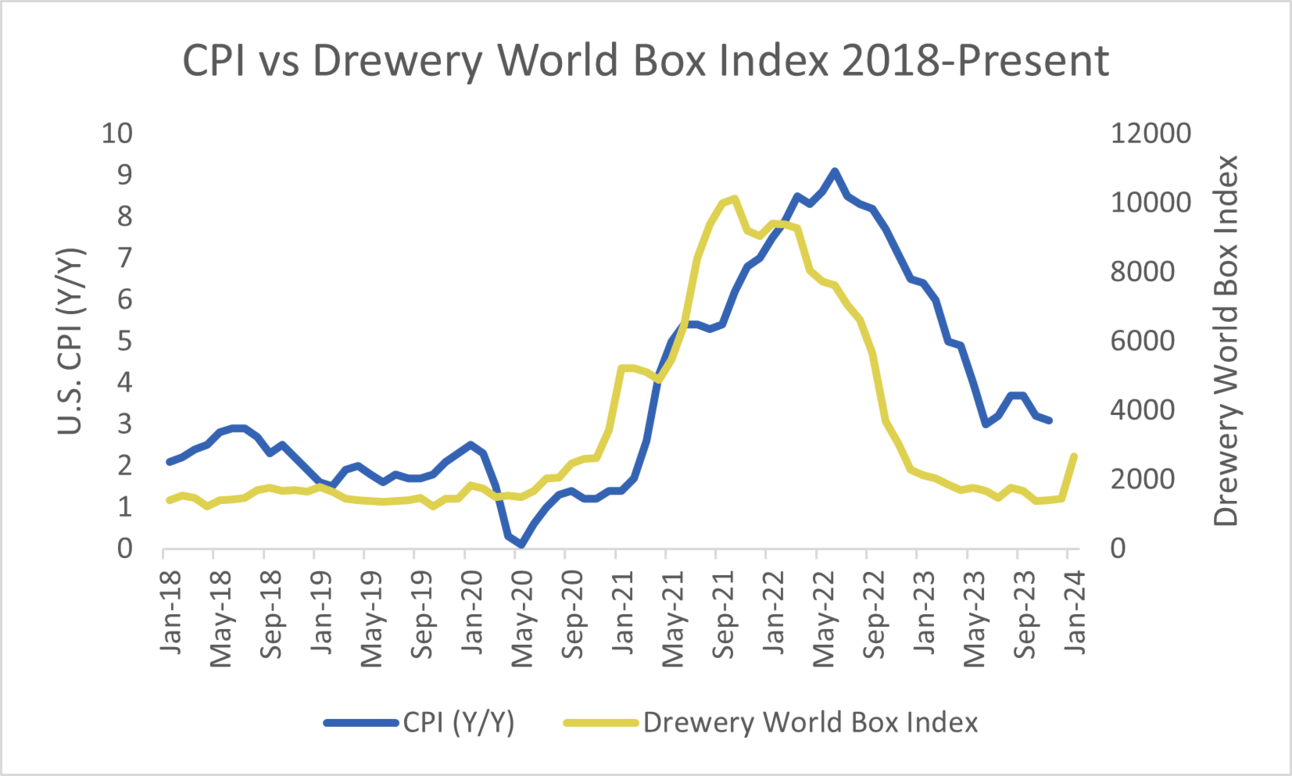
Source: Trade, Truce & Turbulence, Bloomberg, Drewery World Box Index
(1) Iranian-Backed Houthi Rebels Send Containerships Around South Africa
The Iranian backed Houthi Rebels continue to launch drone, missile and amphibious assaults in the Red Sea. Containerized shipping through the Red Sea is at an impasse. As we predicted, Maersk announced an indefinite pause on Red Sea routing after its original two-day pause. MSC, currently avoiding the area, is expected to follow Maersk’s lead during their January 9th re-evaluation. CMA-CGM has taken the most aggressive approach, with French naval escorts, while German Liner Hapag-Lloyd and Israeli ZIM avoid the region.
The pace of Houthi attacks has abated this week. It should not be confused for progress: (1) there are fewer targets to strike with over 70% of containerships diverting around Africa (2) earlier Houthi attacks have completed their desired objectives, forcing containerships around Africa. This week’s actions were likely meant to maintain a level of fear; however, efforts avoided western escalation, which could cut the Houthi victory (disruption) short.
There is little sign that the situation will improve in the near term. The U.S. and its allies have taken a defensive approach, despite whispers of offensive strikes last week. They continue to weigh potential spillover effects in the region given the ongoing Israel-Hamas war. Moreover, it remains unclear whether offensive strikes will prevent Houthi Guerilla style attacks. Houthi attacks require unsophisticated weaponry that are cheap for Iran to fund.
Supply-demand dynamics were expected to be favorable for businesses in 2024. A massive delivery schedule of new ships, improved supply chain performance and uncertainty surrounding 2024’s economic growth had shipping operators expected to take massive losses.
The quantum of TEU (“containers”) being diverted around Africa has quickly changed supply-demand dynamics in favor of shipping operators. It was estimated ~1 million TEU had been diverted last week, now swelling to well over 4 million TEU. Routing around South Africa adds 10-14 days of transit time and creates further issues downstream. Freight rates have soared as a result. Routing through the red sea has driven the Drewery World Box Index’s 99% rise since the low October 26, 2023. However, all trade lanes have benefited.
The spike in freight rates should be raising alarm bells across central banks. A sharp spike in freight rates is a leading indicator of inflation. Freight rates generally account for an insignificant percentage of a good’s end cost. However, they are the result of a supply chain shock that is likely to reverberate, adding incremental costs to production.
90%+ of consumer products are shipped via container across an ocean at least once. More sophisticated products are shipped many times given the number of inputs. The added freight cost is compounded by the extended time it takes producers to get, make and distribute products to end markets.
a
(2) Ethiopia Trades Nationalized Airline Shares for Red Sea Access
Ethiopia lost its access to the Red Sea when Eritrea gained independence via a 1993 referendum. Ethiopia had annexed its northern neighbor in 1962 following more than a decade of conflict and leadership changes. Previously, Eritrea had been colonized by Europe.
Elected in 2018, Ethiopian Prime Minister Abiy Ahmed’s platform stressed Ethiopia’s intention to gain autonomous port access. Within days of taking office, he hinted at re-establishing the landlocked nation’s Navy; it was re-established in 2019, following a 23-year absence. The move made his intentions to claim territory on the coastline clear. In 2018, Ethiopia relinquished disputed lands to Eritrea in an effort to diplomatically gain access to Eritrea’s ports; port access never materialized. In October 2023, Abiy Ahmed suggested neighbors trade their port access for partial ownership of Ethiopia’s largest energy project; a deal failed to materialize. Past failures lead Abiy Ahmed to claim that Ethiopia’s lack of access to Red Sea ports could lead to conflict on October 26th, 2023.
Abiy Ahmed quickly followed the threat of force with a 50-year lease agreement for Somalia’s Berbera port on January 1st, 2024. Importantly, the deal was brokered with the breakaway region of Somaliland. Somaliland, internationally unrecognized and a hotbed for terror organizations, was recognized by Ethiopia and given partial ownership of nationalized Ethiopian Air, Africa’s largest carrier.
Somalia quickly denounced the agreement and expressed their intention to protect their sovereignty by all means necessary. Yesterday, Somalia’s President, Sheikh Mohamud, signed a law nullifying the agreement. It is yet to be seen if Somalia will be able to protect its port, already struggling to sequester internal conflict.
Ethiopia likely views the 50-year lease as the first phase of a broader plan to conquer its neighbor’s coastlines. Temporary port access will enrich the country, allowing it to fund increased military budgets. Moreover, a naval presence on the Red Sea opens another possible attack front for Eritrea and Somalia to defend. Both nations are embattled with their own internal struggles. Abiy Ahmed’s rhetoric is troubling to the region’s safety and sovereignty, describing Ethiopia in its current state as a geographical prison.
a
(3) Ukraine, Israel, Now South Korea Goes on High Alert
Russia’s invasion of Ukraine has been followed with a sweeping rise of global conflict. Many of the U.S.’ most strategic outposts and allies face mounting pressures from Russia, Iran, North Korea and/or China. Have recent escalations left the U.S. military stretched thin?
The Israel-Hamas war wages on. The head of the Israeli Defense Forces (“IDF”) suggested fighting in Gaza would continue for the entirety of 2024 just hours ago. This precedes a visit from U.S. Secretary of State Blinken, who indicated fighting could easily escalate elsewhere in the region. The IDF’s comments, with Blinken’s visit, solidifies the U.S.’ continued support for Israel. However, the U.S. continues to push for more meaningful humanitarian aid into Gaza and reduced civilian casualties.
Israel’s northern border continues to grow tenser, with Hezbollah firing a barrage of 60 missiles towards an Israeli base yesterday. Other militant groups in Syria and Iraq continue to fight in support of Hamas, albeit their capabilities are less significant when compared to Hezbollah.
South Korea went on high alert on January 5th when North Korea launched 200 artillery rounds towards Yeonpyeong Island. The island rests near a contested maritime border. North Korea continued firing artillery in the direction of Yeonpyeong Island Saturday (60 rounds) and Sunday (90 rounds). Rounds fired Sunday followed an announcement from Kim Jong Un’s sister that the nation would immediately strike in response to any South Korean provocation.
The situation remains tense between the two nations, still at war despite long-lasting peace. It also brings back memories from 2010 when North Korea fired 170 artillery shells at the island over a South Korean naval exercise in disputed waters. The 2010 event resulted in 4 South Korean casualties. Thankfully, there have been no casualties due to North Korea’s recent actions at this point.
The above has left the U.S. military supporting two active wars alongside its continued presence in the Asian-Pacific (‘APAC’) to deter Chinese or North Korean incursion into Taiwan or South Korea. The tense global landscape makes diverting resources to/from warzones and deterrence sites increasingly difficult. Strategists must be sure equipment can be returned in an appropriate timeframe if conflict was to ignite. Consideration must also be given to how perceived movements may escalate ongoing tensions or open additional conflict sites elsewhere.
The U.S. is less able to lean on its allies in NATO and APAC than ever for global support. It is demonstrated by the failures of Operation Prosperity Guardian in the Red Sea.
European allies, Poland-exclusive, have long underspent their expected Military budgets. Europe is increasingly aware of the threat Russia presents too. They are unlikely to take on an increased role globally given their underinvestment in the military over the past years.
In APAC, allies are unlikely to take on an increased global presence to: (1) keep resources in deterrence zones to prevent attacks by either China or North Korea; the former regularly violates Taiwanese airspace and the latter is actively at war with its southern neighbor (2) avoid garnering new strategic foes by involving themselves in global military disputes/efforts.
Malign actors are likely colluding to create logistical challenges that erode U.S. military capabilities in effort to destabilize the current world order. The post-World War II world order has resulted in the least violent period in human history.